
What Is Fapelli? A Complete Guide to the Platform
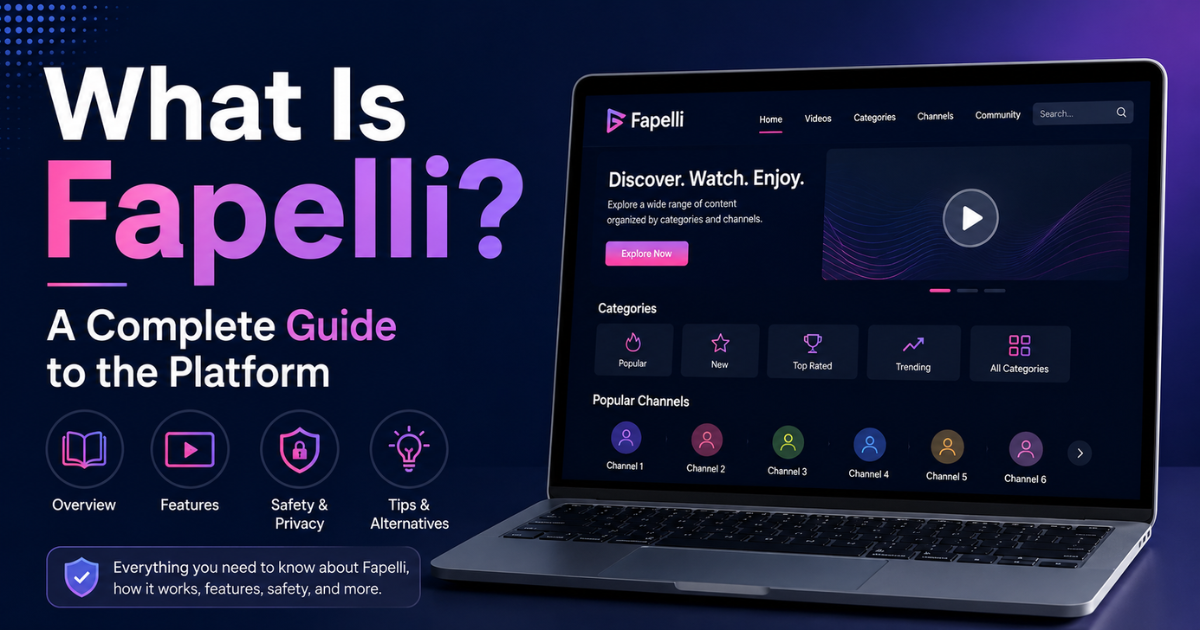
If you recently searched for Fapelli, you may have noticed something unusual: there is no single, universally consistent explanation of what the name represents.
Some online publications describe Fapelli as a modern digital platform built around artificial intelligence, automation, cloud technology, analytics, and business productivity. Other websites use the name in connection with entertainment, creators, digital media, or online communities. Even Fapelli-focused websites acknowledge that independently verified information about the platform remains limited.
That makes researching Fapelli more complicated than looking up an established platform such as Microsoft Teams, Salesforce, or Slack.
This guide takes a practical approach. Instead of treating every online claim as confirmed fact, we will look at what Fapelli is reported to be, how it may work, its commonly mentioned features, potential benefits, limitations, safety considerations, and what users should verify before relying on it.
What Is Fapelli?
Fapelli is a name currently used online in connection with several types of digital platforms and services. The most common description appearing in business and technology publications presents Fapelli as an integrated digital business platform designed to help organizations automate routine activities, analyze information, collaborate with teams, and manage workflows from a centralized environment.
However, this description needs an important qualification.
Publicly available information about Fapelli is inconsistent. There does not appear to be the same level of easily verifiable corporate documentation, product specifications, customer information, or independent technical analysis that users would normally expect from a widely established enterprise software company.
Fapelli.net itself states that online sources describe Fapelli as a digital platform while independently verified information remains limited. It recommends conducting due diligence before using the platform for organizational purposes.
Therefore, the safest description is:
Fapelli appears to be an emerging or loosely defined digital-platform concept that is frequently associated online with AI, automation, analytics, workflow management, and digital experiences, but many specific claims about its capabilities still require independent verification.
Why Is Fapelli Getting Attention?
The interest around Fapelli appears to be connected to broader demand for software that combines multiple business functions.
Modern organizations often use separate applications for:
Project management
Team communication
Data analytics
File sharing
Reporting
Scheduling
Workflow automation
Customer management
Business intelligence
Using many disconnected systems can create additional work. Employees may need to move data between platforms, maintain multiple accounts, switch between dashboards, and manually combine information for reporting.
Several articles describing Fapelli suggest that its proposed value is to bring multiple digital processes together inside one environment.
The concept itself is not unusual. Many modern SaaS platforms are moving toward integrated ecosystems that combine automation, analytics, collaboration, and artificial intelligence.
What makes Fapelli interesting from a search perspective is that people appear to be trying to understand exactly what the name represents and whether the platform is legitimate, useful, or safe.
How Is Fapelli Supposed to Work?
Descriptions of Fapelli found across technology publications generally portray it as a centralized digital system.
The basic idea can be understood through four stages.
1. Data Is Collected
A business platform usually begins by gathering information from users, applications, business processes, or connected systems.
This information could theoretically include:
Task activity
Project progress
Customer interactions
Sales information
Operational metrics
Team performance
Scheduling data
The exact data sources supported by Fapelli should be confirmed directly through official product documentation before implementation.
2. Information Is Organized
Once information enters a centralized platform, it can potentially be organized into dashboards, reports, workflows, or searchable records.
Several descriptions of Fapelli emphasize dashboards and centralized information management.
For companies, centralized visibility can make it easier to understand what is happening without checking multiple applications.
3. Automation Handles Repetitive Processes
Automation is one of the features most frequently associated with Fapelli in existing online coverage.
Reported examples include automating routine activities such as scheduling, reporting, data processing, and administrative workflows.
In principle, business automation can reduce repetitive manual work. But users should distinguish between general claims about automation and features that can actually be demonstrated inside a product.
4. Analytics Help Users Interpret Information
Another feature commonly attributed to Fapelli is analytics.
Existing descriptions mention performance tracking, real-time data, predictive analytics, and customizable reporting.
Analytics can be valuable when businesses need to identify patterns rather than simply store information.
Again, organizations considering Fapelli should request demonstrations showing exactly which analytics tools exist and what data they require.
Key Features Commonly Associated With Fapelli
Because publicly available descriptions vary, the following features should be understood as reported or promoted capabilities rather than independently verified specifications.
AI-Powered Automation
Artificial intelligence is one of the strongest themes surrounding Fapelli.
The platform is frequently described as using AI to reduce repetitive work and assist with decisions.
Potential applications of AI-based automation may include:
Workflow recommendations
Automated reports
Data classification
Pattern identification
Task prioritization
Business insights
The practical quality of these features would depend on the underlying technology, data quality, integrations, and implementation.
Real-Time Analytics
Businesses increasingly want information while events are happening rather than waiting for weekly or monthly reports.
Fapelli-related articles frequently describe real-time analytics and performance monitoring as important parts of the platform.
A real-time dashboard could theoretically help managers monitor operational changes and respond more quickly.
Workflow Management
Workflow management involves organizing the steps required to complete a business process.
For example, a company could create a workflow for:
customer inquiry → employee assignment → follow-up → approval → completion.
A centralized workflow system can make responsibilities easier to understand and reduce unnecessary manual coordination.
Team Collaboration
Some descriptions of the Fapelli platform mention collaboration functions such as task management, file sharing, project coordination, and communication.
This could potentially make the platform useful for remote or distributed teams.
However, businesses should verify whether these tools are native Fapelli features or integrations with third-party applications.
Cloud-Based Access
Fapelli is also commonly associated with cloud technology.
Cloud-based software generally allows authorized users to access systems from different locations and devices without depending entirely on software installed on a single computer.
One benefit can be easier collaboration for teams operating across multiple locations.
Customizable Dashboards
Some Fapelli coverage mentions customizable dashboards that allow users to organize important information according to their needs.
Dashboards can help different departments focus on different metrics.
A marketing manager, for example, may care about campaigns and leads, while an operations manager may prioritize workflows, deadlines, and productivity.
Potential Benefits of Using a Platform Like Fapelli
If Fapelli delivers the capabilities commonly attributed to it, several potential benefits could follow.
Reduced Manual Work
Automation can reduce time spent repeating predictable tasks.
Rather than manually creating identical reports or transferring information between systems, automated workflows may handle parts of the process.
Better Visibility
Centralized dashboards can provide managers with a clearer view of business activity.
Instead of searching through spreadsheets, emails, messaging applications, and project-management tools, important information may be accessible from one interface.
Faster Decision-Making
Timely data can help organizations make decisions based on recent information instead of assumptions.
This is especially useful when market conditions, customer behavior, inventory, or business performance changes quickly.
Improved Collaboration
When tasks, information, files, and communication are available within the same environment, employees may spend less time searching for information.
Scalability
Several publications describing Fapelli present scalability as one of its potential strengths.
Scalable software can be valuable for organizations that expect their number of users, customers, projects, or data requirements to increase over time.
Who Might Be Interested in Fapelli?
Based on how the platform is currently described online, several types of users may be interested in learning more about it.
Small Businesses
Smaller companies often have limited staff and may benefit from tools that reduce repetitive administrative work.
A unified system can also reduce the need to maintain several independent applications.
Startups
Startups frequently change processes as they grow.
Flexible workflows and cloud-based tools can help them adjust without rebuilding their entire operating structure.
Remote Teams
Teams operating from different locations require reliable communication, task management, and information access.
If Fapelli includes the collaboration features attributed to it, distributed teams could represent a relevant use case.
Medium and Large Organizations
Larger organizations may be interested in automation, reporting, analytics, and centralized oversight.
However, enterprise adoption requires substantially more verification around security, access control, compliance, integrations, uptime, support, and data governance.
Is Fapelli Safe?
This is one of the most important questions users should ask.
At present, there is not enough independently verified public information to make a universal claim that Fapelli is either completely safe or unsafe.
Fapelli.net itself states that security should not be assumed without examining the platform’s security and privacy documentation.
Before entering personal, business, financial, customer, or confidential information into any unfamiliar platform, investigate it carefully.
Check for:
A clear privacy policy
Terms of service
Company ownership information
Business contact details
Data-storage policies
Encryption practices
Account-security controls
Data deletion procedures
Regulatory compliance information
Customer-support channels
Independent reviews
Incident or security history
For business use, asking the provider for formal security documentation is particularly important.
Is Fapelli Legit?
The word “legit” can mean several different things.
A website can technically exist while still having unclear ownership or limited independent verification. Likewise, articles discussing a product do not automatically prove that every feature attributed to the product exists.
Current search results clearly demonstrate that the term Fapelli has an online presence, including dedicated domains and coverage on other websites.
What remains less clear is the precise structure and maturity of the organization or platform behind all of these descriptions.
Therefore, users should avoid treating visibility in search results as proof of credibility.
A better approach is verification.
Before subscribing, purchasing, integrating systems, or uploading sensitive information, confirm who operates the service, what the product actually provides, and what protections are available.
Fapelli vs. Traditional Business Software
The primary idea attributed to Fapelli is integration.
Traditional organizations may build a technology stack consisting of several separate tools:
one for communication, another for projects, another for analytics, another for automation, and another for customer data.
An integrated platform attempts to reduce this fragmentation.
That can create convenience, but all-in-one systems also have trade-offs.
A specialized tool may provide deeper functionality for one task, while an integrated platform may prioritize simplicity and connectivity.
Organizations evaluating Fapelli should therefore compare it with established alternatives based on actual requirements rather than marketing descriptions.
Important comparison factors include:
Features
Pricing
Security
Reliability
Integrations
Ease of migration
Customer support
User permissions
Reporting capabilities
Data ownership
Export options
Contract terms
What Should You Check Before Using Fapelli?
If you are considering Fapelli for professional use, conduct a structured evaluation.
Request a Product Demonstration
A live demonstration allows you to see actual functionality instead of relying on third-party descriptions.
Ask the representative to demonstrate the exact workflows you plan to use.
Verify the Company
Identify the legal business entity operating the service.
Look for verifiable company registration information, leadership details, physical or official business contact information, and support channels.
Review Privacy Documentation
Read the privacy policy carefully.
Understand what information is collected, where it is stored, how long it is retained, whether it is shared with third parties, and how users can delete their data.
Examine Security Controls
For organizational data, ask about:
Encryption
Multi-factor authentication
Role-based access
Audit logs
Backups
Breach response
Security testing
Test With Non-Sensitive Data First
If a trial is available, consider evaluating the system using non-confidential information before connecting important business data.
Compare Alternatives
Do not evaluate software in isolation.
Compare Fapelli with established tools offering similar functionality. This provides context around features, pricing, reliability, and support.
Limitations and Concerns
One of the biggest challenges surrounding Fapelli today is not necessarily a particular feature. It is the lack of consistent information.
Different websites describe the name in significantly different ways.
Some frame it as enterprise technology. Others connect it with creator communities, digital media, or entertainment.
That inconsistency creates several problems.
First, users may not know which website represents the platform they are actually searching for.
Second, feature lists appearing on third-party websites may be repeated from other publications without independent testing.
Third, ambitious claims about AI, security, analytics, healthcare, financial technology, or other advanced functions require significantly stronger evidence than a promotional description.
For that reason, readers should distinguish between three categories:
Verified information — supported by clear primary documentation or direct testing.
Reported information — stated by third-party websites but not independently confirmed.
Speculation — assumptions about what the platform could potentially provide.
Making those distinctions is essential when researching unfamiliar digital services.
Why Accurate Information About Fapelli Matters
It is tempting to assume that if several websites repeat the same statement, the statement must be true.
Online information does not always work that way.
Websites can repeat material from one another, and repeated information can create the appearance of consensus even when the original source is unclear.
That is particularly important with emerging technology terms.
Users searching “what is Fapelli?” are not simply looking for promotional language. They want to understand what the platform actually does and whether they should trust it.
Until more authoritative documentation becomes publicly available, the most responsible approach is to describe what is currently reported while clearly identifying what remains unverified.
Frequently Asked Questions
What is Fapelli in simple terms?
Fapelli is a name used online for digital-platform concepts, most commonly associated with business automation, artificial intelligence, analytics, cloud access, and workflow management. However, publicly available information is inconsistent, so individual claims should be verified before relying on them.
What is Fapelli used for?
Technology and business publications describe potential uses including workflow automation, analytics, reporting, project coordination, collaboration, and business management.
Does Fapelli use artificial intelligence?
AI and machine-learning capabilities are frequently mentioned in articles discussing Fapelli. Nevertheless, users considering the platform should verify which AI features are currently available through official product documentation or a live demonstration.
Is Fapelli free?
Reliable public information about a standardized Fapelli pricing structure is limited. Check the specific Fapelli website or service you intend to use for current pricing and subscription information.
Is Fapelli a business platform?
Many current online sources describe it that way, particularly in connection with automation, analytics, and productivity. However, the name is also used by sites with different positioning, making it important to identify the exact platform being referenced.
Is Fapelli safe to use?
There is currently insufficient independently verified information to declare every service using the Fapelli name safe. Review privacy, security, ownership, and terms documentation before submitting sensitive information.
Can businesses use Fapelli?
Fapelli is frequently promoted as a business-oriented platform, but companies should perform due diligence before integrating it into important operations or uploading confidential data.
Why is Fapelli becoming popular?
Interest appears to be driven partly by online discussion surrounding AI, automation, digital platforms, creators, and emerging technology. The ambiguity surrounding the term itself may also cause people to search for explanations.
Is Fapelli the same as Fapello?
They should not automatically be treated as the same service. Fapelli and Fapello are different spellings, and online results associated with them may point to different websites and types of content. Always check the exact domain and service name before proceeding.
Final Thoughts
Fapelli is an interesting example of how quickly an unfamiliar digital name can begin appearing across the web.
The most common business-focused descriptions position Fapelli as an AI-supported platform intended to combine automation, analytics, cloud access, workflow management, and collaboration. At the same time, other websites use the Fapelli name in different digital-media contexts, and independently verified details remain limited.
For readers, the key takeaway is simple: understand the platform before trusting the claims surrounding it.
If you are merely researching Fapelli, current online information can provide a useful starting point. If you intend to register, pay for a service, connect business systems, or provide personal or confidential data, take the additional step of verifying ownership, security policies, privacy practices, functionality, and customer support.
As Fapelli develops and more authoritative information becomes available, its exact identity and capabilities may become clearer.
Celebrity
-
Celebrity

Karen Backfisch-Olufsen: Life, Career, and Legacy of a Private Financial Figure
Karen Backfisch-Olufsen is a well-known name in the world of finance, largely recognized for her strong background in hedge fund trading and her past connection to television personality Jim Cramer. While she has maintained a…
Read More » -

-
-
-


Tech
-
Tech
lamps4u: A Complete Guide to Choosing the Right Lighting for Every Space
Lighting shapes the way a room looks, feels, and functions. The right lamp can make a bedroom calmer, a living…
Read More » -

